By the time audit fieldwork starts, most of the client’s records should already be with the audit team. Each request has gone out, and the client’s finance team knows what is due and when.
In practice, the PBC list goes out as a spreadsheet, and each side starts keeping its own copy. The client’s controller marks a schedule as sent, while the audit senior’s copy still shows it as missing.
Some files also go back to the client to be fixed. Neither copy of the spreadsheet records what was wrong with them.
The name tells you who prepares each item, not who writes the list. PBC in accounting is short for “prepared by client”, and some firms say “provided by client”.
A PBC list is the audit team’s list of the schedules, reports and documents it asks the client to provide. Each item usually has a due date.
Firms also call it an audit request list or a client request list.
The duty starts with the audit engagement letter, or another written agreement on the audit’s terms. In it, management acknowledges its responsibility to provide “additional information that the auditor may request from management for the purpose of the audit” (AU-C 210, ISA 210). For a new audit client, get that letter signed during client onboarding, before the first PBC request goes out.
At the end of the audit, management signs a management representation letter. It confirms that management provided all relevant information (AU-C 580, PCAOB AS 2805).
In France, the statutory auditor (commissaire aux comptes) can have documents handed over on site at any time of year (Code de commerce, Article L821-60). That covers any document the auditor considers useful, including contracts, books, accounting records and minute books.
Every list follows the audit plan, so these rows are examples. A company with no inventory gets no count requests, and a first audit also asks about opening balances.
|
Audit area |
Example PBC items |
What the audit team does |
|---|---|---|
|
Ledger |
Year-end trial balance and general ledger detail |
Agrees the lead schedules and the draft financial statements to the trial balance |
|
Cash |
Bank reconciliations and a list of all bank accounts |
Checks reconciling items, confirms balances with the banks |
|
Receivables |
Aged listing by customer and invoice |
Agrees the total, picks balances to confirm |
|
Inventory |
Count instructions, then the final priced listing |
Attends the count, checks the final listing against it |
|
Fixed assets |
Roll-forward of additions, disposals and depreciation, invoices for large additions |
Agrees it to the ledger, checks additions to invoices |
|
Debt |
Loan agreements, amendments and covenant calculations |
Reads the terms, checks covenants |
|
Legal and governance |
Board minutes, a list of outside lawyers, legal invoices |
Reads minutes for approvals, asks the lawyers about claims |
Some replies should come straight back to the audit team, never through the client.
For confirmations, the audit team selects the items, sends the requests and receives the answers (PCAOB AS 2310, AU-C 505, ISA 505). The client may sign or authorize each request, because some banks and customers only answer when it does.
Where a lawyer’s letter is needed under AICPA and international standards, management prepares it. The audit team sends it, and the lawyer answers the audit team directly (AU-C 501, ISA 501). Under PCAOB AS 2505, the audit team asks management to send it.
The client’s part is the account details and contacts for each confirmation. On the legal side, it supplies the list of outside lawyers, their invoices and a signed letter to each lawyer.
Vague requests come back as the wrong file. Beyond the item, format and due date, each PBC request should also state:
An audit PBC list usually starts from last year’s closed list plus this year’s changes, such as an acquisition. The usual rules for collecting documents from clients still apply: one upload link and one status per item.
Send requests in waves: planning items first, year-end schedules once the books close, follow-ups as fieldwork raises them. Trim any PBC list template so a holding company with no staff never sees payroll requests.
Each type of engagement can have its own reusable request template in Clustdoc. If the client’s planning form shows new loans this year, the loan requests can open for that client only.
When the list lives in email, follow-up questions land in separate threads, away from the request they are about. Keep one live list that the client and the audit team both work from.
Treat received and approved as separate statuses, because the audit team’s checks happen between them. Some items will not apply, such as lease requests for a client that owns its premises. Close those with a one-line reason.
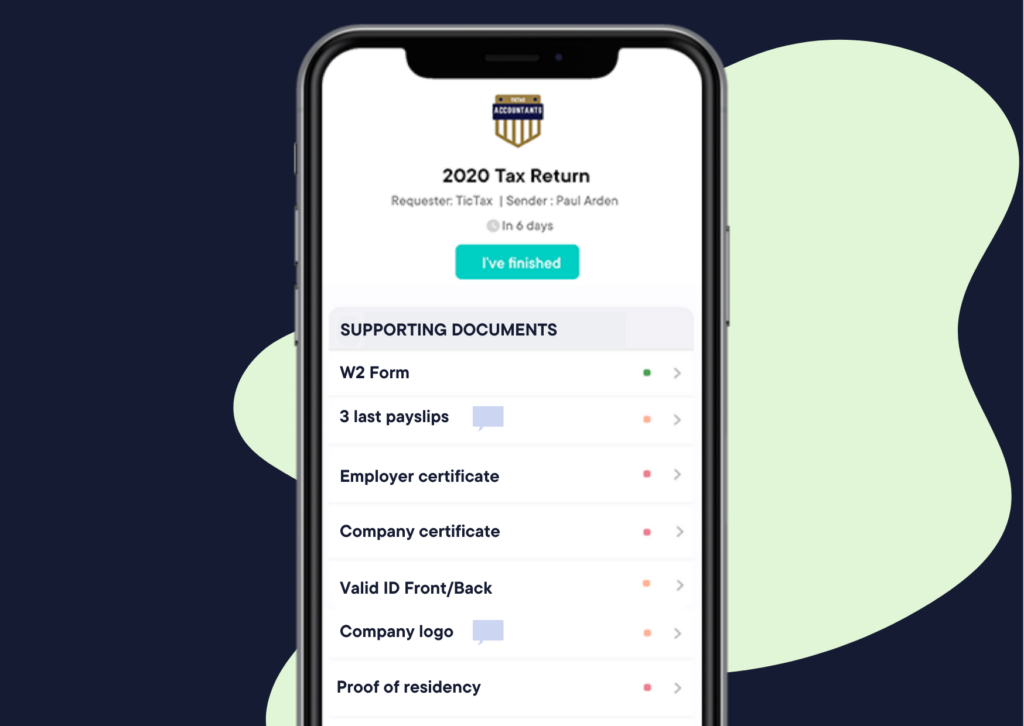
In our accounting client portal, each person at the client sees what is needed from them. A question about the payroll file stays with that request. A reminder can go out as each due date gets close.
Autax, an accounting firm in Melbourne, had the same email problem with its tax clients. It used to email its document list and check every reply by hand before writing back about what was missing. Its team now sees where each client stands and follows up inside our platform.
Who decides that a PBC request is done, and by what date?
A schedule the client prepares is the client’s own work, so it needs testing before anyone relies on it. For information like this, often called IPE, the auditor should test its accuracy and completeness, or the controls over it (PCAOB AS 1105). The auditor should also judge whether it is precise and detailed enough.
AU-C 500 and ISA 500 ask for the same checks where they are needed. The total should agree to the general ledger, the listing should be complete, and the detail should match the request. If an adjusting entry changes the ledger later, schedules approved against the old balance need a second look.
Before a request moves on, a reviewer approves or rejects the file in our approval workflow. Approvals can carry their own due dates too. The testing and the workpapers stay in your audit software.
An item counts only if it is in and approved before the audit report is dated. The report should be dated no earlier than the day the audit team has enough evidence for its opinion (PCAOB AS 3110, AU-C 700, ISA 700). Under PCAOB AS 1215, the audit work and its review have to be done before the report is released.
Close the list when every item is approved or marked not applicable with a reason. Where a file was sent back and replaced, keep the earlier version too. Our audit trail records who uploaded or approved each file, who moved a deadline, and the date of each action.
After the report date, assembling the file is administrative work: no new audit procedures and no new conclusions (AU-C 230, ISA 230). For PCAOB audits, the final file should be archived no more than 14 days after the report release date (AS 1215).
That applies to fiscal years beginning on or after 15 December 2025. Firms that issued audit reports for more than 100 issuers in calendar year 2024 started a year earlier. Before that, the limit was 45 days, which still applies to audits of earlier fiscal years.
AU-C 230 allows up to 60 days after the report release date. International standards ordinarily allow no more than 60 days from the date of the auditor’s report (ISA 230).
Book a demo call and we will show one request list from both sides: what the client’s finance team sees and what your audit senior sees.
PBC stands for "prepared by client", and some firms say "provided by client". A PBC list sets out each schedule, report and document the client is asked to provide. The audit team writes the list, and the client's finance team prepares the items.
A PBC schedule is one analysis the client prepares for the audit. Examples are the fixed asset roll-forward, the aged receivables listing and a debt schedule. Each one should agree to the general ledger and show enough detail for the audit team to test individual items.
PBC says who provides an item: the client. IPE, information produced by the entity, says who made it: the company's systems or staff.
Many PBC items, such as system reports, are IPE. A bank statement is not.
For fiscal years beginning on or after 15 December 2025, PCAOB AS 1105 also covers the electronic copy a client provides of an outside document like that. The audit team tests whether the client changed that copy, or tests the client's controls over it.
It can. Without other evidence, the audit scope is limited.
Under AU-C 705 and ISA 705, a possible effect that is material but not pervasive means a qualified opinion. If it could also be pervasive, the auditor disclaims an opinion.
When management imposed the limit, withdrawing from the audit is also open where practicable. ISA 705 makes withdrawal the first choice in that case. In PCAOB audits, a significant restriction imposed by the client ordinarily means a disclaimer (AS 3105).
Still stitching emails, files, and approvals together?
Clustdoc gives teams one place to run client-facing work, boost customer engagement and increase compliance.

Claire writes about customer onboarding, digital processes, and the day-to-day challenges faced by operations teams. At Clustdoc, she focuses on practical insights: how organizations collect information, guide customers through complex steps, and improve service delivery with automation.