A new employee and a new client may both need forms, documents, instructions, and follow-ups, but the two onboarding processes have very different goals. One helps a person settle into a role inside your business.
The other helps a customer start working with your business and reach value as quickly as possible. Treating them as the same process can create unnecessary steps and confusion on both sides.
This guide looks at employee onboarding vs client onboarding, where the two processes overlap, where they need to stay separate, and how the right tools can support each one.
Employee onboarding gets a new hire set up inside your company. Client onboarding gets a new client set up to work with you.
Both collect forms, documents, and signatures, so similar tools fit both. Clustdoc handles document-heavy onboarding either way. The difference is direction: one process points into your company, the other points out of it.
The employee onboarding process starts the day someone accepts your offer. It runs through their first weeks and often their first months. Most teams call it new hire onboarding or HR onboarding, and it points inward, toward your own company.
The administrative side collects and confirms a standard set of items:
The human side matters just as much. A good onboarding checklist also covers training sessions, introductions to the team, and a clear first project. Many teams send the paperwork before day one, so the first morning is about people rather than forms.
Client onboarding starts once the sale closes. Its job is to move a new client from signed deal to active account without friction. It points outward, toward a person or business that can still walk away.
A typical client onboarding flow includes:
The exact steps depend on the industry. A law firm collects case files, a lender collects income proofs, and an agency collects brand assets and platform access. The shape of the onboarding process stays the same even when the contents change.
The two processes share paperwork, but the shape of the work is not the same. The table below sums up the contrast, and the sections that follow explain each row in more detail.
|
Question |
Employee onboarding |
Client onboarding |
|---|---|---|
|
Who goes through it |
A new hire inside your company |
An external client or account |
|
Main documents |
Contract, tax forms, policies |
Intake forms, agreements, compliance files |
|
Who owns it |
HR and the hiring manager |
Sales, operations, or account teams |
|
Typical length |
Weeks to months |
Days to weeks |
|
Measure of success |
A productive, settled employee |
An active, confident client |
Employee onboarding starts after someone accepts a job. They expect some admin, such as payroll forms, system access, equipment setup, and team introductions.
Client onboarding is more sensitive because the customer is still judging their decision. For example, a new accounting client may need to send tax records, company details, and signed forms. If those requests arrive across several emails, the process quickly feels disorganised.
Employee paperwork is usually fairly consistent. HR may collect an employment agreement, tax details, bank information, identification, and policy acknowledgements.
Client requirements depend on the service. A marketing agency may need brand files and account access, while an accountant may ask for financial statements and company records. Some industries also require identity checks or KYC documents, which means files must be reviewed as well as collected.
HR usually manages employee onboarding, while the hiring manager handles training, introductions, and role-specific tasks.
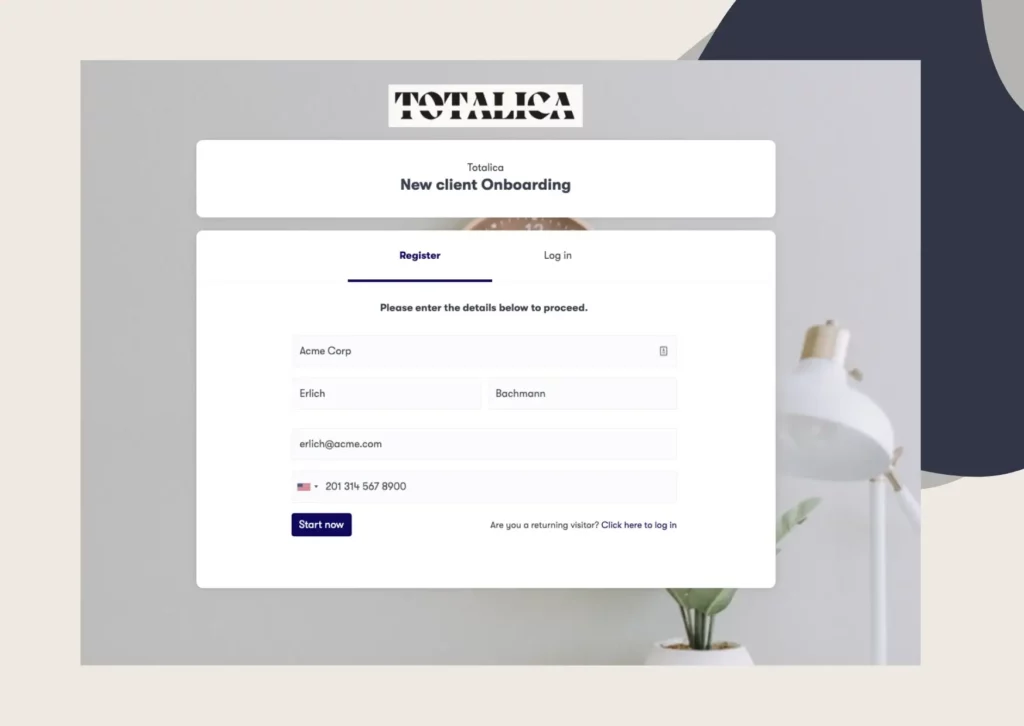
Client onboarding may involve sales, operations, or an account manager. Because the customer deals directly with the process, presentation matters. One portal with clear tasks usually feels much easier than several email threads with different attachments.
Employee onboarding can continue for several months. Paperwork may finish in the first week, but training and performance milestones often continue through 30, 60, and 90 days.
Client onboarding is normally shorter. The aim is to get the customer set up and seeing value within days or weeks, not months.
For employees, useful measures include time to productivity, 90-day retention, and new-hire feedback.
For clients, teams often track time to first value, onboarding completion rate, and the number of reminders needed. If customers complete the process quickly without repeated follow-ups, the onboarding process is usually working well.
Strip away the labels and both processes do the same mechanical work. They send forms, request documents, chase signatures, and track who has finished what. That overlap is why one platform can run both sides.
Our platform was built for document-heavy onboarding of exactly this kind. It brings online forms, document collection, eSignatures, and task management into one branded workspace.
Automated reminders chase whatever is still missing, so your team sends fewer follow-up emails by hand. Our customers report cutting onboarding time in half once those chases stop being manual.
For new hires, our ready-made staff onboarding template combines task lists, document collection, and contract signing in a single flow. The template handles the paperwork half of the job. For the human half, our guide to the employee onboarding process walks through building a five-star first month.
Start from the person you are onboarding, not from the software. For new hires, map the journey first: offer, paperwork, equipment, training, and checkpoints. For clients, map the path from signed contract to first delivered result.
Then look at how much of that path is made of forms, documents, and signatures. When most of it is, one platform can carry both processes. Your team then maintains a single system instead of two.
Most teams end up needing both processes eventually. Growing headcount brings new hires, and growing revenue brings new clients, so a shared system saves rework later.
Clustdoc fits the document-heavy version of both cases. If that sounds like your onboarding, Book a demo call and see how it fits your process.
Onboarding is the process of getting someone new set up and working in a new relationship. The onboarding meaning is the same for employees and clients, only the direction changes.
For employees, it means joining your company and reaching full productivity. For clients, it means moving from a signed contract to an active account.
Mostly, yes. HR onboarding usually refers to the administrative part, such as contracts, payroll forms, and policy sign-offs. Employee onboarding, sometimes called staff onboarding, is the broader term that also covers training, introductions, and ramp-up.
The most common types of onboarding are employee onboarding, client onboarding, vendor onboarding, and user onboarding for software products. Each one differs in who is being onboarded and what gets collected. All of them move a person through set steps toward an active relationship.
Often, yes. Both processes rest on forms, document collection, signatures, and reminders, which is what onboarding platforms automate.
Before committing, check that the platform supports client-facing use. Internal HR tools rarely present well to people outside the company.
Still stitching emails, files, and approvals together?
Clustdoc gives teams one place to run client-facing work, boost customer engagement and increase compliance.

Claire writes about customer onboarding, digital processes, and the day-to-day challenges faced by operations teams. At Clustdoc, she focuses on practical insights: how organizations collect information, guide customers through complex steps, and improve service delivery with automation.