What happens if a new employee starts work before your HR team has completed the required checks? In the UK, missing a right to work check can lead to fines of up to £60,000 per illegal worker. Other missed checks could mean hiring someone without the qualifications or clearance their role requires.
Pre-employment checks help you confirm a candidate’s identity, right to work, employment history and suitability for the job. Some are legally required, while others depend on the position.
This guide explains which checks UK employers need, when to complete them and how to keep track of everything before a new hire starts.
Pre-employment screening covers the checks an employer makes on a candidate before they start work. The pre-employment screening checks UK employers carry out depend on the law, the role and their own hiring policy.
For example, every new hire needs a right to work check, while criminal record checks depend on the job. Many employers make the job offer conditional on these checks. GOV.UK says a conditional job offer can be withdrawn if the person does not meet the employer’s conditions.
HR runs these checks alongside the rest of candidate onboarding, such as the contract and payroll forms. The candidate provides documents and details, while referees and official bodies handle their own parts.
For each check, the table shows who does it, when it happens and where the rule comes from.
|
Check |
Who does it |
When |
Source |
|---|---|---|---|
|
Right to work |
HR, with the candidate’s share code or original documents |
Before employment starts, and again when a time-limited right is due to expire |
GOV.UK, Home Office guide |
|
Identity |
HR, as part of the right to work and criminal record checks |
With those checks |
Home Office guide, GOV.UK |
|
References |
HR or the hiring manager, with referees the candidate names |
Usually after the job offer |
Your hiring policy |
|
Qualifications and registration |
HR or the hiring manager |
Before the start date, if the role needs them |
The job’s requirements |
|
Criminal record |
HR or the candidate applies, and the candidate receives the certificate |
Usually before the start date, at the level the role allows |
GOV.UK, mygov.scot, nidirect |
|
Health |
HR, the candidate and, with written consent, their doctor |
After the job offer, with a few exceptions |
Equality Act 2010, GOV.UK |
|
Driving licence |
The candidate shares a check code, and HR checks it online |
Before the start date, for driving jobs |
GOV.UK |
GOV.UK says you must check that a job applicant is allowed to work for you in the UK before you employ them. The Home Office employer’s guide gives three ways to do it. You can check original documents, use the Home Office online service or use a registered digital verification service.
You cannot insist on one method. The right one depends on the candidate’s nationality and immigration status, and sometimes on their preference. For example, British and Irish citizens cannot get a share code, but eVisa holders need the online check.
For a manual check, you must hold the original document, with the candidate present in person or by live video. A scan or photo of a passport does not count. You must also be satisfied that the person you check is the one who will do the work.
With references and qualification checks, you confirm what a candidate has told you about their work history and skills. Which ones you need depends on the role and your hiring policy.
The candidate gives you their referees’ contact details and copies of any certificates the role requires. HR or the hiring manager then contacts each referee and compares the certificates with the job’s requirements.
If the job needs a professional registration, check it with the professional body.
In England and Wales, employers get criminal record checks from the Disclosure and Barring Service (DBS). GOV.UK lists four levels:
Only certain roles are eligible for a more detailed check, for example in healthcare or childcare. DBS sends the certificate to the candidate, so ask to see it and check it is genuine.
You must also have a policy on employing ex-offenders and show it to any applicant who asks.
Scotland and Northern Ireland have their own services for criminal record checks.
Disclosure Scotland offers four disclosure levels, from Level 1, which replaced the basic disclosure, to the Protecting Vulnerable Groups (PVG) scheme. It’s a legal requirement to join the PVG scheme for anyone doing a regulated role with children or protected adults.
In Northern Ireland, AccessNI issues basic, standard and enhanced checks. Employers apply for standard and enhanced checks through a body registered with AccessNI. It is an offense for an employer to ask a candidate to get their criminal history from the police.
The law limits when you can ask a candidate about their health. Under the Equality Act 2010, employers in England, Scotland and Wales must not ask about health before offering work. There are a few exceptions, for example asking whether a candidate needs help to take part in an interview.
For successful candidates, GOV.UK says you can only ask for a health check if the law or the job requires it. You should mention any health check in the offer letter. You also need the candidate’s written consent before you ask their doctor for a report.
Some jobs require additional checks before you can hire someone. For example, if you’re hiring a delivery driver, you’ll want to confirm that they have a valid driving licence and can legally drive the vehicles they’ll use at work. You should also check that they don’t have any penalty points that could affect the job.
You can check this through the GOV.UK driving licence service if the candidate has a licence issued in England, Wales or Scotland.
To complete the check, ask the candidate for their driving licence check code and the last 8 characters of their licence number. The code is valid for 21 days, so make sure you use it before it expires.
You also need the candidate’s permission to access their details. GOV.UK warns that obtaining someone else’s personal information without their permission is a criminal offence.
The time depends on which checks the role needs and how quickly each person or service replies. Official sources give these timings:
References and qualification checks have no official timing, because they depend on how quickly referees and other organizations reply. So start the DBS application and the reference requests as soon as the offer is accepted.
HR collects a lot of personal data during these checks, including sensitive health and criminal record information. GOV.UK says that when you collect it, you must tell people who you are and how you’ll use their information. That includes telling them if you share it with other organizations.
Only collect the information each check needs. GOV.UK also advises storing health and criminal record details separately, with access limited to the right staff.
Keep right to work records for the whole employment and for two years after it ends, then destroy them securely. Disclosure and Barring Service (DBS) guidance says to use certificate information only for the purpose the candidate consented to. It also says not to keep that information longer than necessary after the recruitment decision.
For many checks, the candidate has to send something first, such as referee details, certificates or a share code. On paper, that can mean several emails and office visits for each new hire.
Our employee onboarding software gives each candidate one online checklist to complete from any device. With it, new hires at Specialist Care Team, a UK home care agency, no longer make repeat office trips with the wrong ID.
We collect what candidates send and pass each file to the colleague who reviews it. Your HR team still makes the checks themselves.
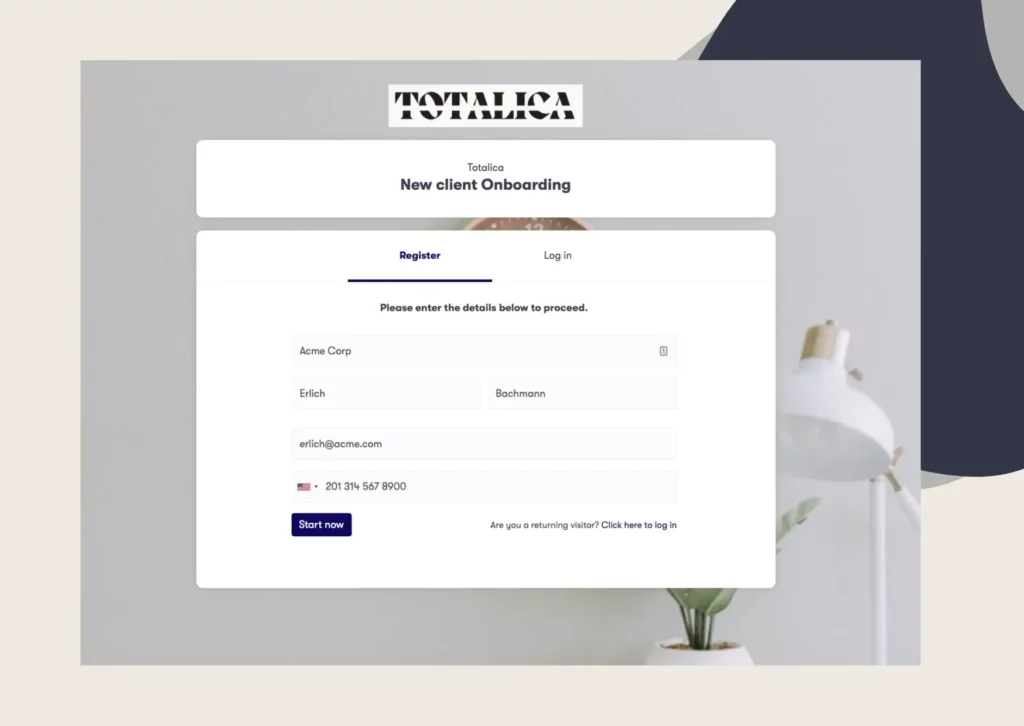
HR can adapt one of our staff onboarding templates for each role, listing only the documents that role needs. With conditional forms, each candidate then gets only the requests that fit their answers. For example, a candidate who chooses to prove their right to work online sees a field for their share code.
Document approvals let HR accept each certificate or reject it with a comment. The candidate then sees any rejected file on their checklist.
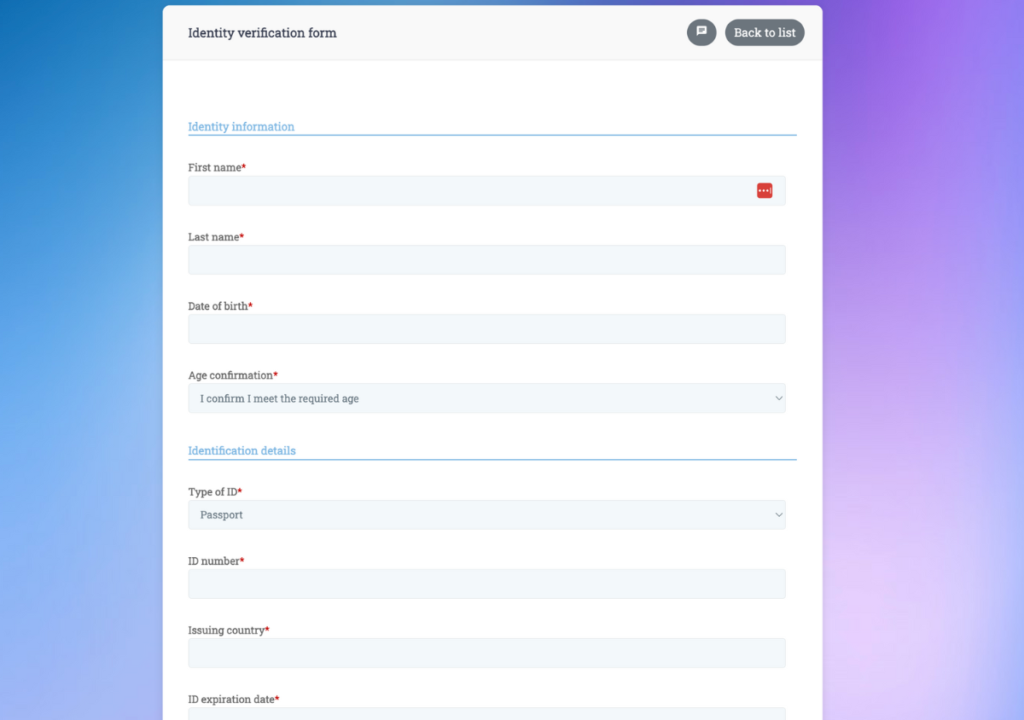
HR can also put identity verification first and approve each candidate’s ID before they continue. This is separate from the right to work check, which HR still makes by one of the Home Office methods.
Our platform can send automatic email and text reminders when a document is still missing or a deadline is near.
Your team’s own work is tracked as internal tasks, each with an owner, a due date and a status. For example, HR can own the right to work check while the hiring manager owns the reference calls.
With role-based permissions, you choose which colleagues can open a candidate’s health answers or ID documents. We comply with the General Data Protection Regulation (GDPR), and our platform is SOC 2 Type II certified. It also keeps a timestamped audit trail of every action.
Book a demo call and bring the checks one role needs, from the right to work to references. We will walk through who does each check and how the candidate could send their part online.
They are the checks a UK employer makes before someone starts work, to confirm they can legally do the job. They usually cover the right to work, identity and references, plus a criminal record check for some roles.
Pre-employment screening is another name for pre-employment checks. Some employers use a screening company for parts of it, but the Home Office guide says the employer stays responsible for the right to work check.
They involve collecting documents, details and references, then checking them yourself or through an official service. For example, HR checks the right to work and applies for any criminal record check the role needs. In Clustdoc, candidates send their part through one online checklist, and HR approves each item.
It depends on the checks the role needs. An online right to work check gives real-time information from Home Office systems, but criminal record checks take longer.
GOV.UK says a basic Disclosure and Barring Service (DBS) check takes up to 14 days. Standard and enhanced checks usually take around 8 weeks, while references depend on how quickly referees reply.
Still stitching emails, files, and approvals together?
Clustdoc gives teams one place to run client-facing work, boost customer engagement and increase compliance.

Claire writes about customer onboarding, digital processes, and the day-to-day challenges faced by operations teams. At Clustdoc, she focuses on practical insights: how organizations collect information, guide customers through complex steps, and improve service delivery with automation.
This material is for informational purposes only. Nothing in it constitutes legal, financial, or other professional advice or carries any assurance of legal validity in any jurisdiction. Clustdoc shall not be liable for the material or for any action taken on the basis of it.