A company sends over its details, the paperwork looks fine, and everything seems ready to move forward. Then one name does not match the official record.
Or the ownership section is missing. Or nobody can clearly explain who actually controls the business.
That is where the easy part ends.
Before you accept a company as a client, you need to know who is behind it and whether the information you were given checks out. This article goes through the KYB process step by step, then looks at the documents, ownership checks and red flags that can slow a file down.
You cannot find a company’s owners until you know which company you are dealing with. So know your business (KYB) checks start there, with the company record, and end with approval.
Start with the official company record, not the application form. In the US, search the Secretary of State business database in the state where the company was formed. For a UK company, search Companies House.
Check the legal name, company number, date formed, official address and status, such as active or dissolved. Then ask the client for the certificate of incorporation or a recent extract from the company registry. Save a dated copy of the record you checked.
UK firms under the Money Laundering Regulations 2017 must verify the name, company number and registered office address (regulation 28). EU rules ask for similar details, so confirm your own list with your compliance officer.
Some clients write a trading name on the form instead of their legal name. Ask for the legal name, then check the record again.
A client’s form lists a director who has since resigned. So compare the directors and officers on the form with the official record.
In the UK, Companies House lists current and resigned officers, so you can see who has left. If the record shows a current director the form leaves out, ask the client why.
Next, confirm who will act for the company, such as the person opening the account or signing the contract. Ask for a board resolution or a signed letter of authority, plus that person’s ID. If the signer is not a director, the letter should name them and say what they may sign.
EU and UK rules require firms to check that this person is authorized to act and to verify their identity. Your policy may also ask for ID checks on every director, not only the signer.
Who owns or controls the company in the end, even through other companies? Those people are its beneficial owners. Ask for an ownership chart that shows every layer, then run an ID check on each owner.
US banks must identify anyone owning 25 percent or more, plus one person who controls the company (31 CFR 1010.230). EU rules treat a stake above 25 percent as a sign of ownership, and countries may set it lower. From 10 July 2027, that line becomes 25 percent or more.
Even when nobody reaches that share, you still identify whoever controls the company by other means. If nobody does, EU and UK rules point to its senior managing official. UK firms cannot rely only on the ownership details filed at Companies House (regulation 28).
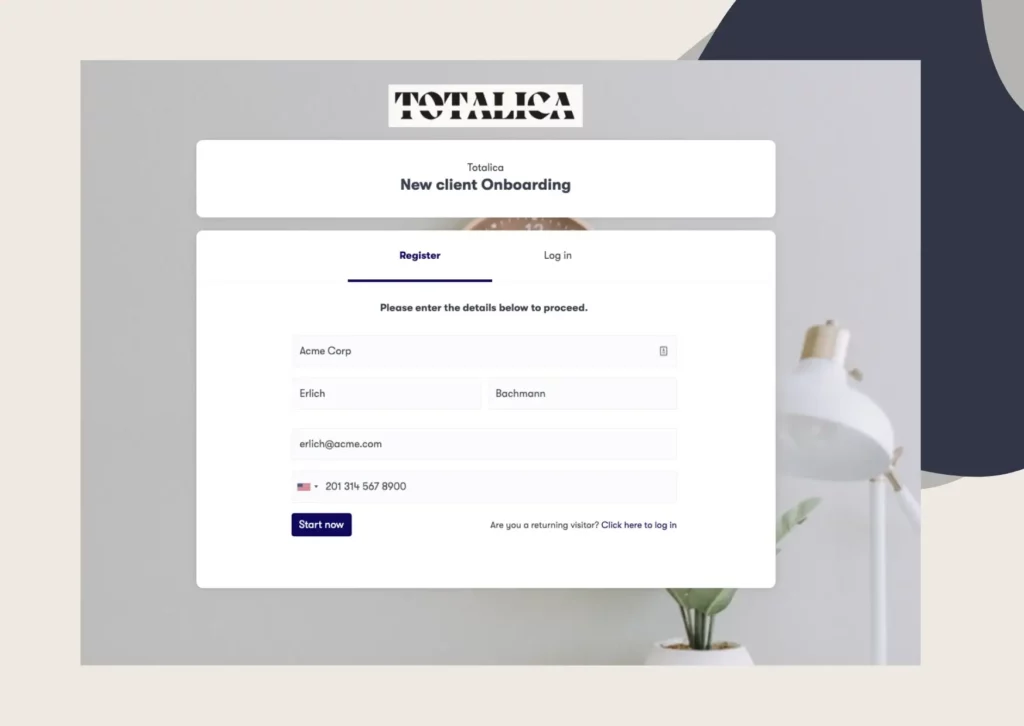
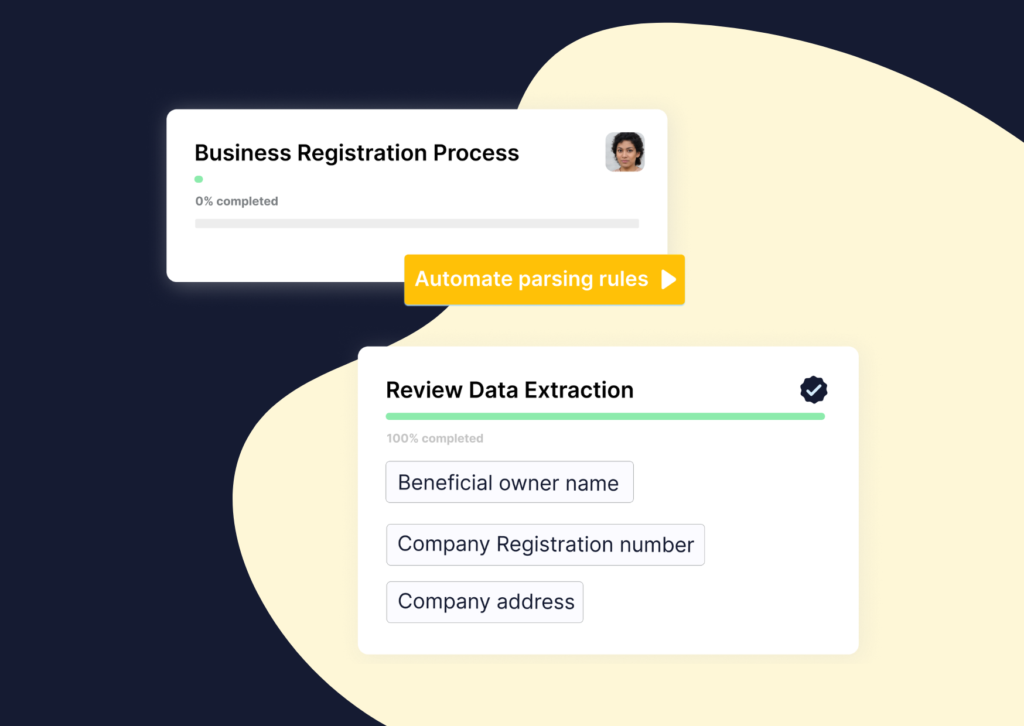
Clustdoc’s KYC and KYB verification checks government-issued IDs, selfies and business registration documents inside the onboarding flow.
Run the company name, each director and each beneficial owner against sanctions lists. Check the directors and owners against politically exposed person (PEP) lists too. Then search the news for reports of fraud or corruption linked to any of them.
A company can be a sanctions risk even when its own name is clean. From 10 July 2027, EU firms must check whether sanctioned people control it. They must also check whether those people own more than half of it (Regulation (EU) 2024/1624).
When a name matches, the file pauses while a reviewer checks the company number, country and dates of birth. They write down whether the match was cleared or kept, and why. Save the date of each screen and the lists used in the client file.
A local bakery applying for a card terminal expects small card payments from nearby customers. A cross-border payments company expects large transfers between many countries, so it needs more questions and more proof.
What a business does changes how deep the review goes. Find out what the company sells, where it operates and what payments it expects. For higher-risk clients, ask for proof of where the money comes from, such as recent bank statements.
Compare the company’s website with what the application says. If the website or address raises doubts, hold the file until you check if a company is legit.
An ownership structure that looks too complex for the business is a warning sign (Regulation (EU) 2024/1624, Annex III). We can also score each application against your rules and flag high-risk or incomplete ones for manual review.
Once every check is done, compliance approves or rejects the file. Some firms also bring in an auditor or another outside reviewer to sign off. Our approval workflow sends the file to each approver in order.
With guest access, an outside reviewer works only on their own step, without full access to our platform. The audit trail time-stamps every upload and every approve or reject decision.
Set expiry dates on IDs and other documents, so your team knows when to ask for new copies. Recheck the file when owners or directors change, and look at higher-risk clients sooner. Companies House can also email you when a UK company changes its directors or address.
A public record can confirm the company. It cannot tell you everything you need, and two recent changes show why.
In the UK, company directors and people with significant control have had to verify their identity with Companies House since 18 November 2025. Existing directors confirm it when they file their next annual confirmation statement, inside a 12-month transition.
In the US, there is no public federal list of company owners. Companies formed in the US stopped filing beneficial ownership details with FinCEN in March 2025. A final rule in August 2026 made that permanent.
A state record shows that a company exists and who its officers are, not who owns it.
Plan for two sources instead of one. Official records confirm the company, its number, its address and its filed officers. The ownership chart, the signer’s authority and each owner’s ID come from the client.
When the client’s answers and the official record disagree, write down which one you accepted and why. That note is what an auditor reads later.
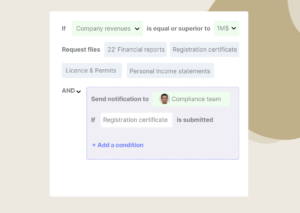
Ask for these files in your first request, so the client does not get a second list later:
Not every client needs every file. KYB requirements differ by country and business type, so match the list to the company and its risk.
You can request and review each document in one place, then accept or reject it. Automatic reminders go out for anything still missing.
KYC and KYB use the same ID checks for people, but KYB adds the company and everyone behind it.
|
What differs |
KYC |
KYB |
|---|---|---|
|
Who is checked |
One person |
The company, its directors, signers and owners |
|
Core documents |
Passport or driver’s license, proof of address |
Registry extract, articles, ownership chart, IDs of key people |
|
Ownership check |
Usually not needed |
Everyone who owns or controls the company |
|
Typical example |
A bank opening a personal account |
A payment company taking on a new merchant |
Our KYC onboarding software runs KYC and KYB checks in the same client portal. The company’s files and each owner’s ID check stay in one place.
Book a demo call to see a KYB flow in Clustdoc that collects company files, checks owners’ IDs and routes approvals.
The letters KYB stand for know your business. It means making sure a business client is a real company and learning who runs it and who owns it. All of this happens before you start working together.
The checks use official company records, the company's own documents and ID checks on the key people. They help stop companies from being used to hide who is really behind the money.
KYB compliance rules come from anti-money laundering laws, so they vary by country and business type. The global standard is FATF Recommendation 10, which asks firms to identify a company client's beneficial owners. National rules set the details, such as the ownership share that counts, so confirm yours with your compliance officer.
Under a final rule from August 2026, US companies no longer file beneficial ownership reports with FinCEN. Banks and other covered firms must still identify the owners of company clients.
Every firm that falls under anti-money laundering rules has to check its company clients. In the EU, that includes banks opening business accounts, payment companies taking on merchants and lenders approving business loans.
The UK's Money Laundering Regulations 2017 also cover auditors, insolvency practitioners and letting agents. US owner checks apply to banks, broker-dealers, mutual funds and some futures firms (31 CFR 1010.230).
It depends on how complete the first submission is. A file moves quickly when the company record matches the form, the ownership chart covers every layer and no name matches a screening list.
It slows down when the client sends a trading name instead of the legal name, leaves an owner off the chart, or has to find a board resolution. Ownership spread across several countries adds the most time.
Update it when something changes, like a new owner, new director or expired passport. Also recheck on a schedule based on risk. From 10 July 2027, EU rules cap the gap at one year for higher-risk clients and five years for others.
In the US, a February 2026 FinCEN order ended the need to recheck owners at every new account. Banks now only have to recheck when facts cast doubt on owner details or their risk procedures require it.
Still stitching emails, files, and approvals together?
Clustdoc gives teams one place to run client-facing work, boost customer engagement and increase compliance.

Claire writes about customer onboarding, digital processes, and the day-to-day challenges faced by operations teams. At Clustdoc, she focuses on practical insights: how organizations collect information, guide customers through complex steps, and improve service delivery with automation.