
For many SaaS companies, customer onboarding starts the moment a new user logs in.
But if you’re working in a high-touch SaaS environment, you know this process can also start much earlier than that.
For your teams, customer onboarding journey begins before your customer sees a single screen, which makes customer onboarding even more critical than it already is.
If the goal of any onboarding process is to help users reach the full potential of a product as fast as possible, for high-touch B2B SaaS, that goal requires a foundation that most customer onboarding frameworks skip entirely: getting the right information, documents and configuration in place before access is ever granted by your customer success team.
Our SaaS customer onboarding checklist is for the teams managing the critical period between a signed contract and actual product access, where everything either comes together or (hopefully not anymore) falls apart.
If you run a payroll platform, a financial infrastructure tool, a compliance product or any enterprise SaaS that requires customer provided data before the environment can be configured, then your customer onboarding is a mission critical process.
It determines risk exposure, shapes the customer experience and directly affects whether your product can be used at all.
For these industries the goal is really to orchestrate complex customer onboarding workflows, automate document collection and ensure every compliance requirement is met before a single user logs in.
And since you can’t configure what you don’t have, until your customer submits their company registration, their integration requirements, their historical data or their compliance documentation, your team is waiting and so is your customer’s access.
Teams that manage the activation gap ad hoc consistently see delays, incomplete submissions and frustrated customers who could lead to customer churn before they ever really get to the product.
But teams that run a stronger customer onboarding process close that gap faster, deliver a cleaner handoff and set the tone for a stronger long term relationship which directly drives overall customer satisfaction.
Our new SaaS customer onboarding checklist for software companies was built to streamline the handoff moment, when your sales team closes the deal and passes the customer to your onboarding team or account managers.
Your customer success managers can then use our checklist to involve directly the customer and keep track of the critical onboarding steps required before a customer can access the product.
Most teams using our template face the following challenges:
• The product can’t function without customer provided configuration data
• The team must collect, review and validate documents before access is granted
• The customer journey may vary depending on the type of customer or need to happen step by step
• Multiple internal stakeholders are involved in the activation process
• They need a repeatable, cohesive customer onboarding program across their entire customer base
So if your current customer onboarding process involves chasing information across email, manually tracking who submitted what or redoing the whole thing from scratch for every new account, this checklist gives you a starting point to fix that.
The onboarding stages below reflect the natural sequence of a customer onboarding or activation workflow. After you download this template you’ll be able to adapt the following onboarding tasks to fit your operational requirements.
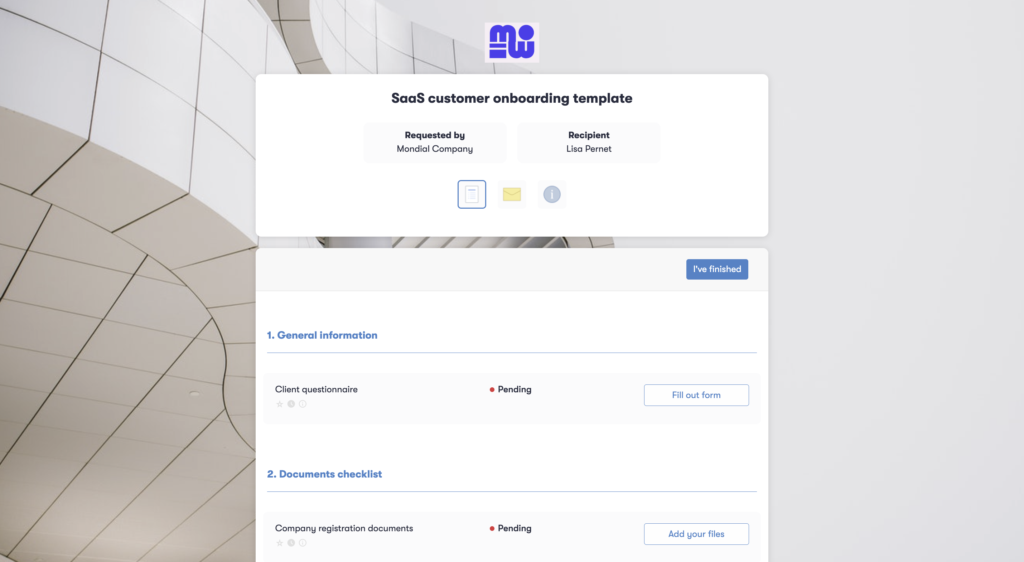
Clustdoc simplifies your SaaS onboarding process by providing a centralized platform to manage all intake activities efficiently. It ensures clear ownership by immediately assigning a customer success manager, setting transparent expectations, and guiding users through the initial steps with ease.
The intake stage is about ownership. Assigning a CSM immediately and making that visible to the customer signals that they are in good hands.
This is also the best moment to set user expectations clearly: what the onboarding flow will look like, what they’ll need to provide and when they can expect access. Using Clustdoc, you can guide users through these steps from the very first touchpoint automatically you reduce confusion and speed up the activation stage.
Most teams typically use a combination of digital forms, customer relationship management (CRM) systems, and project management tools to capture initial customer information.
This is highly inefficient because information and documents are managed across multiple disconnected systems.
Usign our Saas customer onboarding checklist, you can automatically trigger data capture from inside the same workspace. At this stage this is usually what you’ll need to ask:
• Customer profile information
• Operational requirements
• System configuration details
• Technical and integration requirements
Key features and workflows needed for launch
Without the right tool, thos is typically the stage where delays would happen. Customers are not always sure what information you need, in what format or why.
Personalizing the request and framing it around their specific use case rather than a generic form improves response rates and reduces back and forth, because the more clearly you guide users through what is required upfront the faster this stage moves.
Incomplete document submissions are also one of the biggest source of delays in the customer onboarding process for regulated industries. Using this template, you provide customers with a clear and dynamic document checklist (based on customers profiles and specificities) that reduces back and forth by a significant margin and keeps the process on track.
• Company registration documents
• Compliance documentation (if applicable)
• Operational records and historical data
• Documents to be reviewed by the onboarding team
This stage is invisible to the customer but it determines the activation experience. If internal validation is disorganized your customers feel it through delayed timelines, last minute requests for additional documents and inconsistent communication. A clean validation stage is what makes the handoff to product access feel smooth and professional. As part of this template, you’ll have internal tasks assigned to your customer success managers to handle all milestones and approvals.
• Customer information verification against submitted documents
• Technical configuration
• Customer environment preparation and testing
• Compliance requirements
• Account setup finalization and sign off internally
Activation is the finish line for your onboarding team and the starting line for everything else. That is pretty much where you’ll share critical information with your customers. All these steps are also part of our SaaS customer onboarding checklist template.
• Customer environment creation
• User accounts configured and access credentials
• Welcome communication including next steps and available resources
• Ongoing support resources and knowledge base access
Clustdoc was built for the activation gap.
Instead of managing your customer onboarding process through email and spreadsheets you create a structured onboarding workspace where customers submit information and documents through a guided customer onboarding flow, step by step, with full visibility on both sides.
Your team can then track user progress, review submissions, validate data and manage onboarding tasks from a central dashboard.
In the background our automation engine handles the routine touchpoints such as submission confirmations, missing document alerts, status updates, so your team can focus on the work that actually requires human judgment.
Every account follows the same onboarding program so nothing falls through the cracks and no customer gets a worse onboarding experience because their CSM is having a busy week.
Download our template to get started
A good SaaS customer onboarding checklist should cover the entire onboarding process from deal close to product access.
That means customer intake and ownership assignment, structured information collection, document submission, internal validation and activation.
It should also include a way to track customer progress across all client onboarding stages so your team knows at any point which customers are on track and which are at risk of delay.
Our template provides you with a comprehensive checklist for your team as much as a workflow for your customer. Our checklist approach ensures users complete the essential steps in sequence and significantly reduces drop-off during the activation phase.
Client onboarding for high-touch sales and Enterprise SaaS happens before product access is granted.
On the other hand, SaaS user onboarding happens inside the product after activation: it’s about helping users navigate the interface, adopt core features and move through the user journey to meaningful usage.
It usually involves guided product tours, in-app welcome messages and feature walkthroughs designed to help new users reach value quickly. Both are part of the broader customer onboarding journey but serve entirely different purposes and require different onboarding tools.
Time-to-activation is the most direct metric, how long from deal close to product access.
Completion rate (the percentage of new customers who finish the full onboarding program) tells you how many are dropping off before activation.
To go even further, you can also track the following metrics:
Daily active users in the weeks following activation indicate whether onboarding actually set customers up for real product usage.
Feature adoption rates reveal whether customers are engaging with the capabilities they signed up for or just logging in.
You should also track user progress through each onboarding stage and gather feedback systematically to identify friction points.
Together these metrics give you a clear picture of how your customer onboarding strategy is performing and where to improve it.
Book a call to discuss your needs with our experts.