Merchant onboarding is one of the most sensitive processes for payment providers, acquiring banks, ISOs, and fintech platforms.
On paper, it often starts with a simple merchant onboarding form.
In practice, the onboarding journey requires far more than a data collection form.
It involves a structured, multi-step merchant onboarding checklist that captures business information, verifies ownership, reviews bank account details, gathers documentation, routes files to underwriting, and ensures every compliance requirement is met before activation.
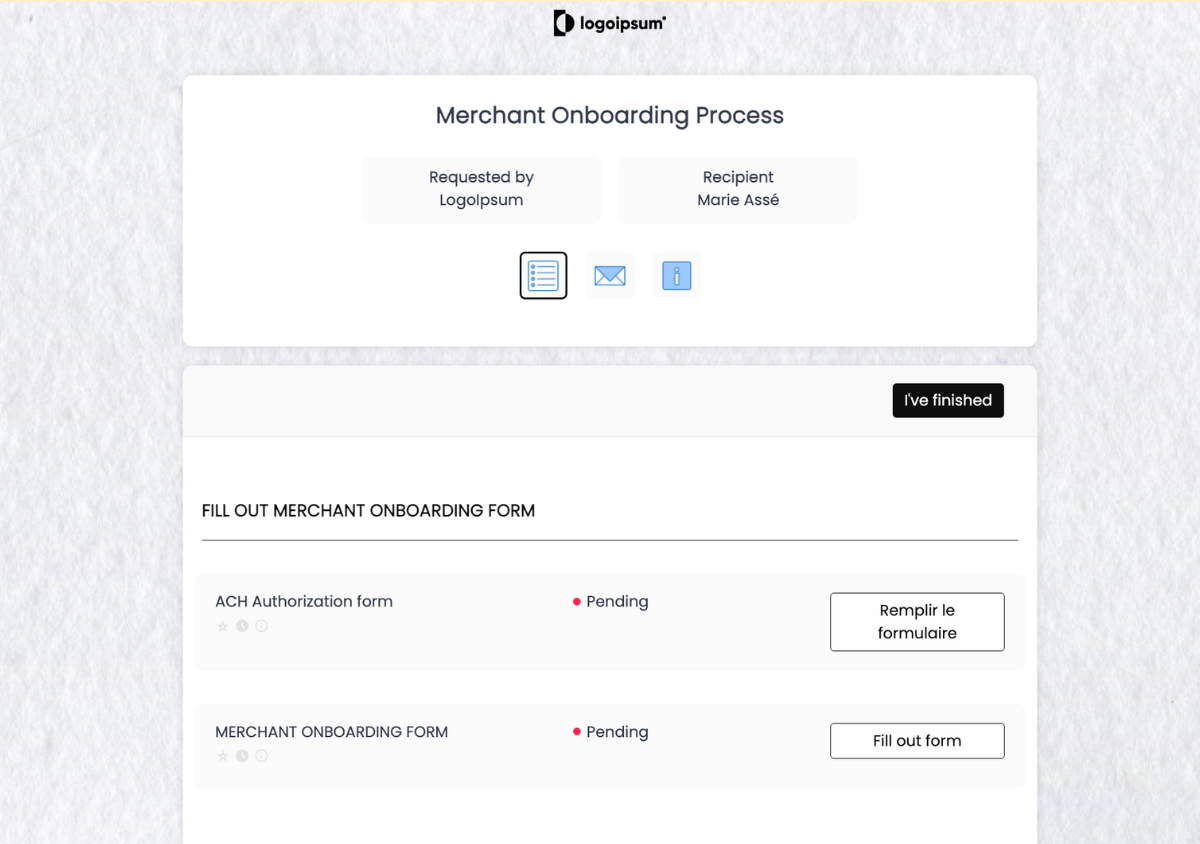
We’ve built this template to handle that entire workflow in Clustdoc.
It combines form fields, document uploads, signatures, validation rules, review steps, and internal approvals into a single, trackable onboarding process.
Instead of relying on disconnected forms, emails, and attachments, your merchant onboarding becomes a guided, auditable sequence that ensures accuracy, consistency, and operational control from start to finish.
Payment providers face operational, regulatory, and financial exposure when onboarding new merchants.
A missing business license, an unverifiable bank account, unclear ownership information, or an incorrect business address can lead to onboarding delays, payout issues, chargeback exposure, or compliance findings from banking partners.
That’s exactly what this Clustdoc workflow solves.
Our standardized combination of onboarding form plus checklist helps your teams collect all the information required for underwriting right from the start.
You can verify identity and ownership before risk scoring, ensure documentation is accurate and complete, and avoid repeated back and forth with merchants.
Files get routed to the right internal teams automatically, you maintain a complete auditable onboarding record, and legitimate merchants get activated faster.
This means you can scale onboarding without sacrificing accuracy or control.
Business information and identity details
The onboarding form captures the merchant’s business name, full legal name, business address, country of registration, website URL, and contact information.
These details form the basis for identity verification and help confirm the legitimacy of the entity.
New merchants also provide operational descriptions and service delivery timelines, all organized in structured fields within Clustdoc.
Ownership and UBO information
Regulators require visibility into ownership structures, and our workflow makes this easy.
You gather data about shareholders, directors, and the ultimate beneficial owner (UBO), including identity documents and ownership percentages.
Capturing this information upfront in Clustdoc supports compliance checks and mitigates fraud risk before you even move to underwriting.
Bank account verification for payouts
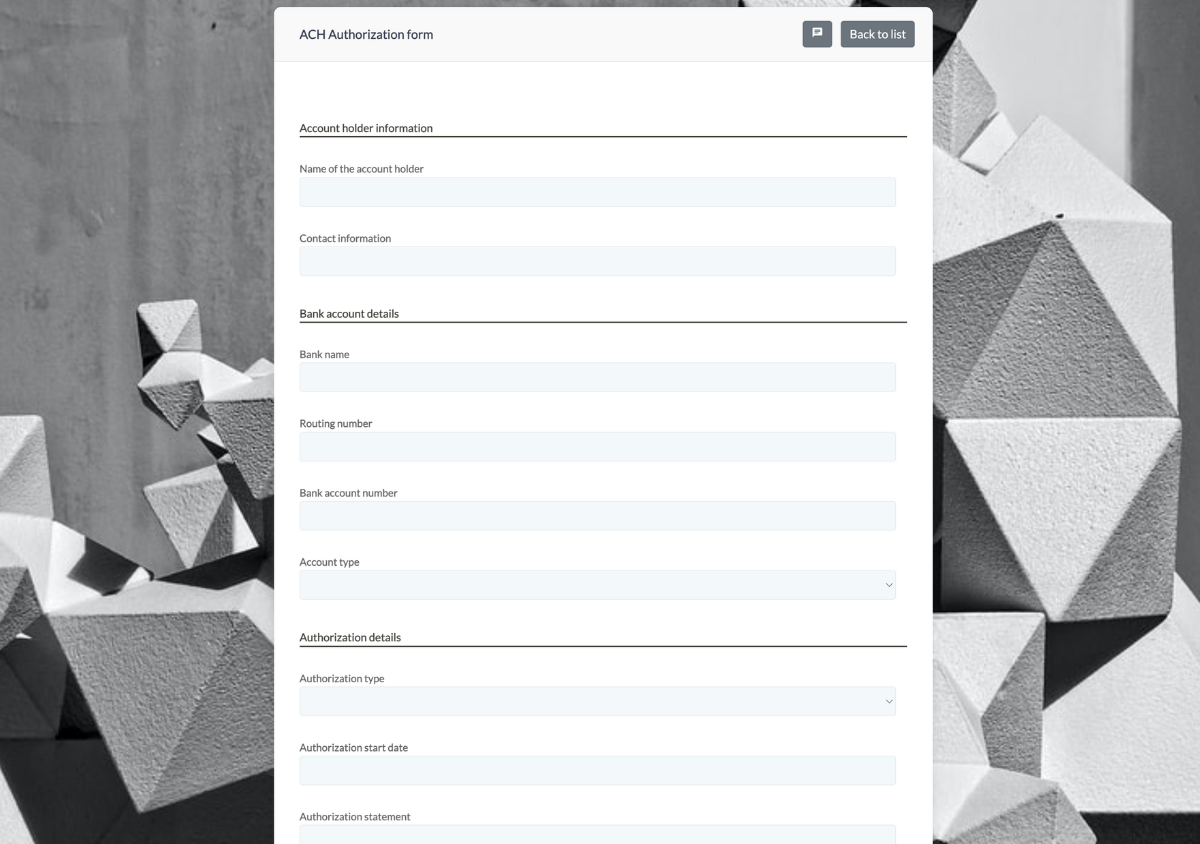
Our merchant onboarding checklist includes fields for the merchant’s bank account, account number, routing or ACH details, and a document confirming account ownership.
With everything collected in one workflow, your team can validate banking details without chasing merchants through email.
Products, services, and business model details
We know that underwriters need to review the merchant’s product categories, pricing model, refund policy, service delivery schedules, and customer touchpoints.
Our workflow structures this information clearly, helping you determine whether the merchant fits your risk appetite and whether enhanced review is required.
Everything stays organized in your Clustdoc workspace.
Required documents and verification files
We’ve built dedicated sections where merchants can upload documents like business licenses, incorporation documents, proof of address, government-issued ID, bank statements, and financial documents.
These files flow directly into your review pipeline, helping internal teams validate the information submitted through the form without manually sorting through email attachments.
Agreements, disclosures, and signatures
Merchants can sign processing agreements, fee disclosures, and service terms directly within the onboarding journey in Clustdoc.
This ensures contractual acceptance before account activation and centralizes all compliance-relevant documentation in one secure location.
No more tracking down signed contracts weeks after onboarding started.
Internal review and approval steps
Our workflow includes structured review tasks for underwriting, risk, and operations teams.
It ensures information is validated, documents are checked, and approval decisions are recorded in a consistent format.
You can assign tasks, set deadlines, add review notes, and maintain full transparency across your team.
Traditional onboarding relies on standalone forms, email attachments, and manual back and forth.
This creates long delays, incomplete files, and inconsistent decisions.
We’ve replaced that fragmented approach with a single, guided merchant onboarding process in Clustdoc that covers form submission, documentation collection, identity and ownership verification, bank account validation, routing to underwriting, internal reviews, and final approval.
Because everything is centralized in your Clustdoc workspace, your teams can track progress in real time, request missing information through automated reminders, maintain accuracy across every application, and ensure that no required step is missed before activation.
This creates a more predictable onboarding experience for merchants and a more controlled, auditable process for payment providers.
Try Clustdoc today, launch your new workflow tomorrow.