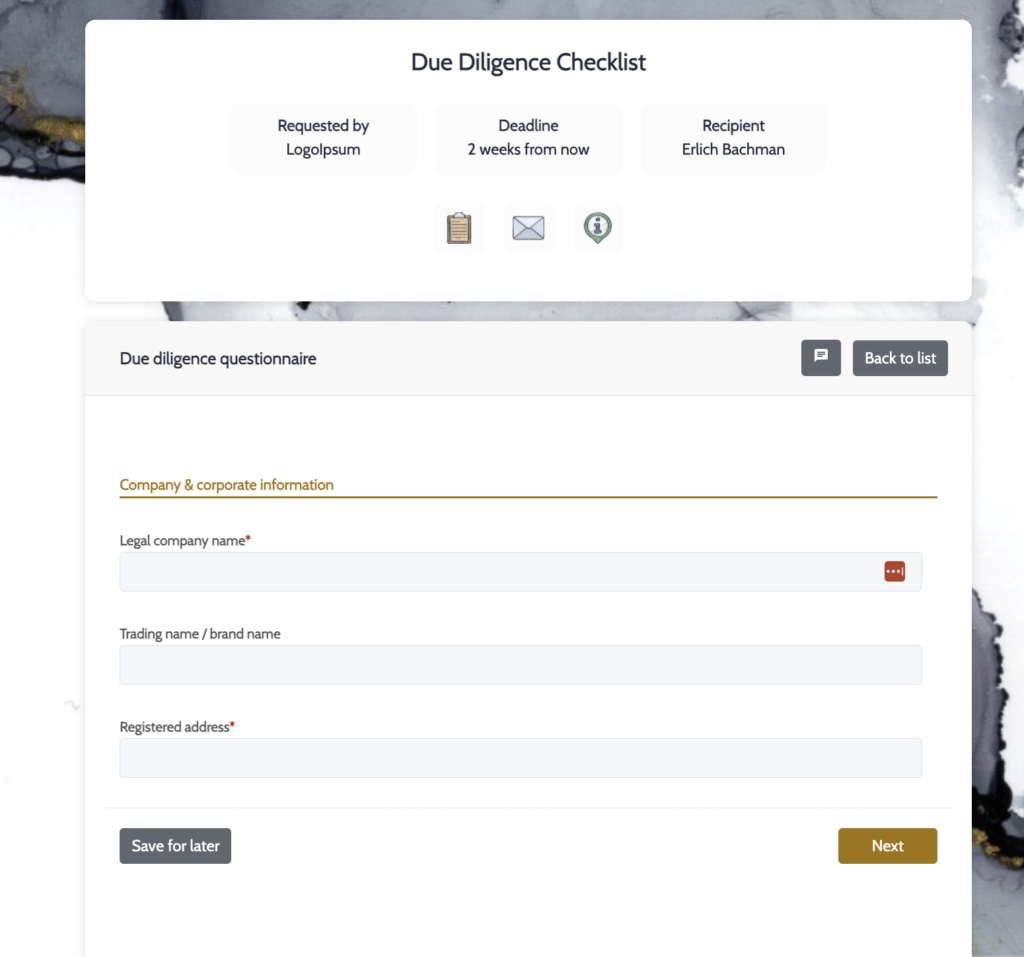
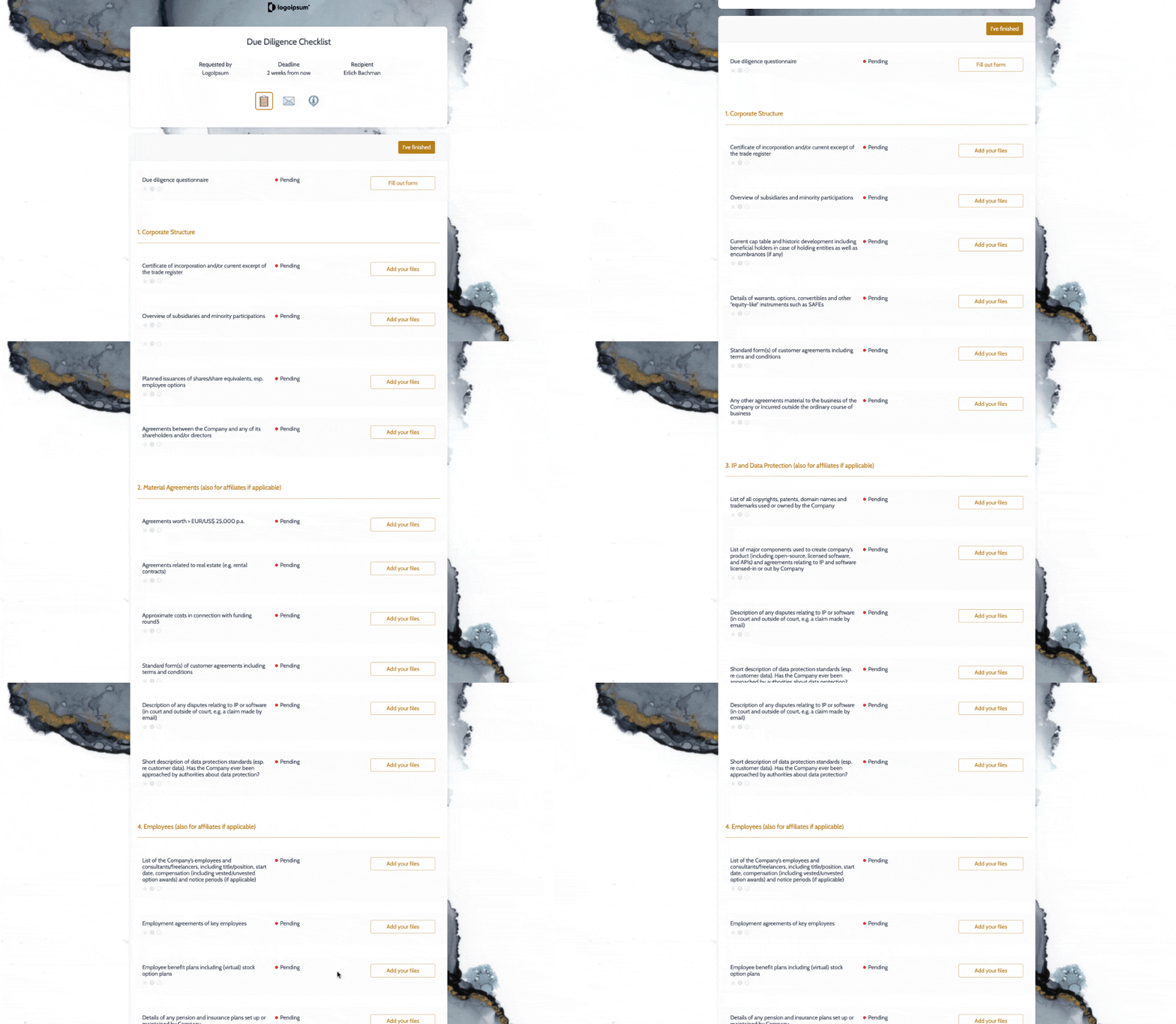
Due diligence questionnaire

This due diligence questionnaire helps organizations standardize how information is collected, reviewed, and assessed before entering a business relationship.

*Fully customizable & easy to add to your due diligence checklist

What is a due diligence questionnaire and what is it used for?

A due diligence questionnaire (often called a DDQ) is a structured questionnaire that organizations use to collect detailed information about a company, vendor, supplier, or partner before entering into a business relationship or make a strategic decision.

Businesses use a diligence questionnaire as a critical tool to support a broader due diligence process and gather the same information in a consistent format across different departments, stakeholders, and transactions.

DDQs are usually used:

• onboarding a new business partner or supplier

• assessing a target company during mergers or acquisitions

• performing a vendor assessment as part of your third-party risk programs

• reviewing third party relationships that affect your operations or supply chain

• supporting investors during decision making phases

Due diligence questionnaires are an important part of risk management for any organization.The goal is to assess risks, verify important information, and ensure alignment with current regulations, industry standards, and your internal practices.

By centralizing responses, documents, and reviews, your organization gains visibility into risks that could impact your operations, reputation, or legal standing.

On a day to day basis, due diligence questionnaires are widely used across different industries, especially in regulated environments where legal compliance, data protection, and governance requirements apply to every day operations.

How a due diligence questionnaire fits into the overall diligence process?

A diligence process usually involves multiple stages (which can be mapped in your Clustdoc checklist), and the due diligence questionnaire plays a central role early on.

Typically, a due diligence process follows this structure:

First, internal teams need to identify the parties involved and scope the review.

Then they’ll send one or several diligence questionnaires to collect detailed information.

Once they receive the questionnaire, they’ll review responses and collect supporting documents.

Next, they’ll perform a risk assessment across key areas.

And finally escalate findings for approval and decision making.

Because most organizations manage multiple DDQs over time, using standardized questionnaires that can be reused across different workflows, helps ensure that you collect the same information consistently, regardless of the industry, transaction type, or internal team involved.

What information does the Clustdoc due diligence questionnaire template include?

While formats vary, most effective DDQs focus on key areas that allow organizations to evaluate operational, legal, and financial exposure.

Corporate and legal information

This section of your questionnaire focuses on the company, its corporate structure, ownership, and governance.

• legal entity details

• shareholders and control

• licenses and registrations

• interactions with regulatory bodies

The above information will help you verify that the organization you’re dealing with is subject to supervision, operates under the same regulations and complies with applicable legal frameworks.

Financial information

Our due diligence questionnaire also requests relevant financial information, such as:

• financial statements

• revenue sources

• outstanding debt

• potential liabilities

This will support your internal teams in evaluating financial stability and exposure.

Operational processes

Here, the goal is to help your organization assess how the company runs its operations:

• core business activities

• dependencies on suppliers

• internal controls and workflows

• continuity planning, including disaster recovery plans

Understanding operational processes is essential for your assessment of scalability, resilience, and execution risks.

Compliance, security, and data

Many due diligence questionnaires include a security questionnaire component, especially when data access or processing is involved in the business relationship.

Typical topics include:

• data protection policies

• information security controls

• incident management and data breaches history

• alignment with current regulations and industry standards

This section is particularly relevant for vendor and third-party reviews.

Clustdoc workflows that rely on due diligence questionnaires

As seen above, there are many diligence questionnaire examples, depending on your context.

• In mergers and acquisitions, your questionnaire focuses heavily on the target company, legal exposure, and financial data.

• In a vendor relationship, your emphasis may be on security questionnaire topics, data protection, and operational dependencies.

• In a new business relationship, your questionnaire helps establish baseline trust and compliance before any exchange of sensitive data.

As your organization grows, managing DDQs becomes more complex. Multiple teams, different departments, and external parties are often involved in your DDQ process.

With Clustdoc, you’ll be able to create and save your DDQs in your toolbox allowing your teams to reuse these questionnaires accordingly in different workflows based on your use case and once your teams receive a completed questionnaire, several steps usually follow:

-> Collect supporting documents based on your DDQ output

Once the questionnaire is submitted, all responses are captured in a single Clustdoc process checklist linked to that specific due diligence case.

Each section of the questionnaire is preserved and can be used to trigger document requests to the right parties. Documents are uploaded by the counterparty are automatically attached to the relevant sections, which allows your teams to review answers and evidence very easily.

-> Route reviews to the right teams

Once the questionnaire is submitted, all responses are captured in a single Clustdoc process checklist linked to that specific due diligence case.

Each section of the questionnaire is preserved and can be used to trigger document requests to the right parties. Documents are uploaded by the counterparty are automatically attached to the relevant sections, which allows your teams to review answers and evidence very easily.

-> Trigger approvals and decisions

Based on predefined rules or manual validation, Clustdoc allows your teams to move from review to decision without exporting information elsewhere. Decisions are taken directly in the context of the questionnaire and its supporting documents.

Each decision remains linked to the underlying responses, which makes outcomes easier to justify and explain.

-> Track progress and accountability

As the process unfolds, Clustdoc provides a shared view of progress across all active due diligence cases. Your teams can monitor the status of questionnaire completion, track reviews that are in progress or pending, identify any outstanding questions or remediation requests, and oversee approval stages and decisions.

-> Keep a clear record for governance and compliance

And once the full application process is completed, the questionnaire, reviews, decisions, interactions and documents remain centralized, creating a durable record that enables your organization to demonstrate how decisions were made, respond efficiently to audit or regulatory requests, and reuse relevant information for future reviews when appropriate. An audit trail also tracks all activities since day one to support your compliance requirements.

Yes. You can transfer your existing questionnaires into Clustdoc and organize them as you wish in your forms toolbox.  Some customers prefer to keep them current standards while others would reorganize sections or break the forms into sub-forms in Clustdoc for a better user experience.


Yes. Questionnaires in Clustdoc are designed to be managed directly by your business teams.

You can create, edit, or reorganize questions without technical intervention. Legal, compliance, or operations teams can adjust questionnaire content as your requirements, internal practices, or regulatory context evolve.

Once your Due diligence questionnaire is ready, you can then add that as a step to complete in your compliance workflows. 

Yes. Due diligence questionnaires are usually built as templates so they can be reused across different flows.

Forms adding operational overhead to your teams?

Try Clustdoc today, launch your new workflow  tomorrow.