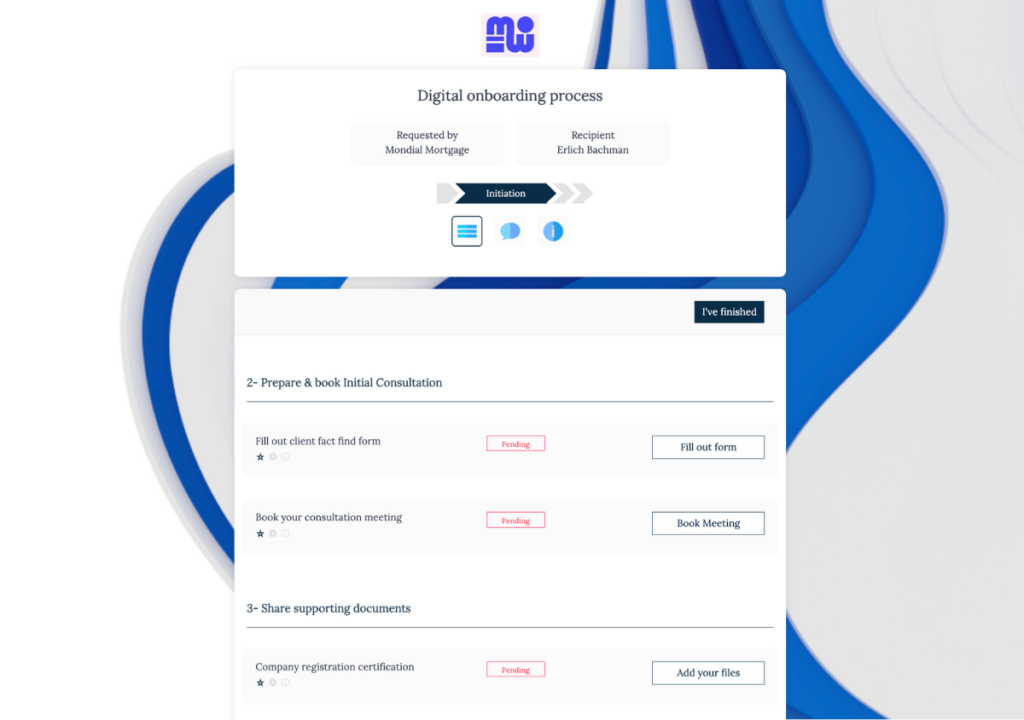

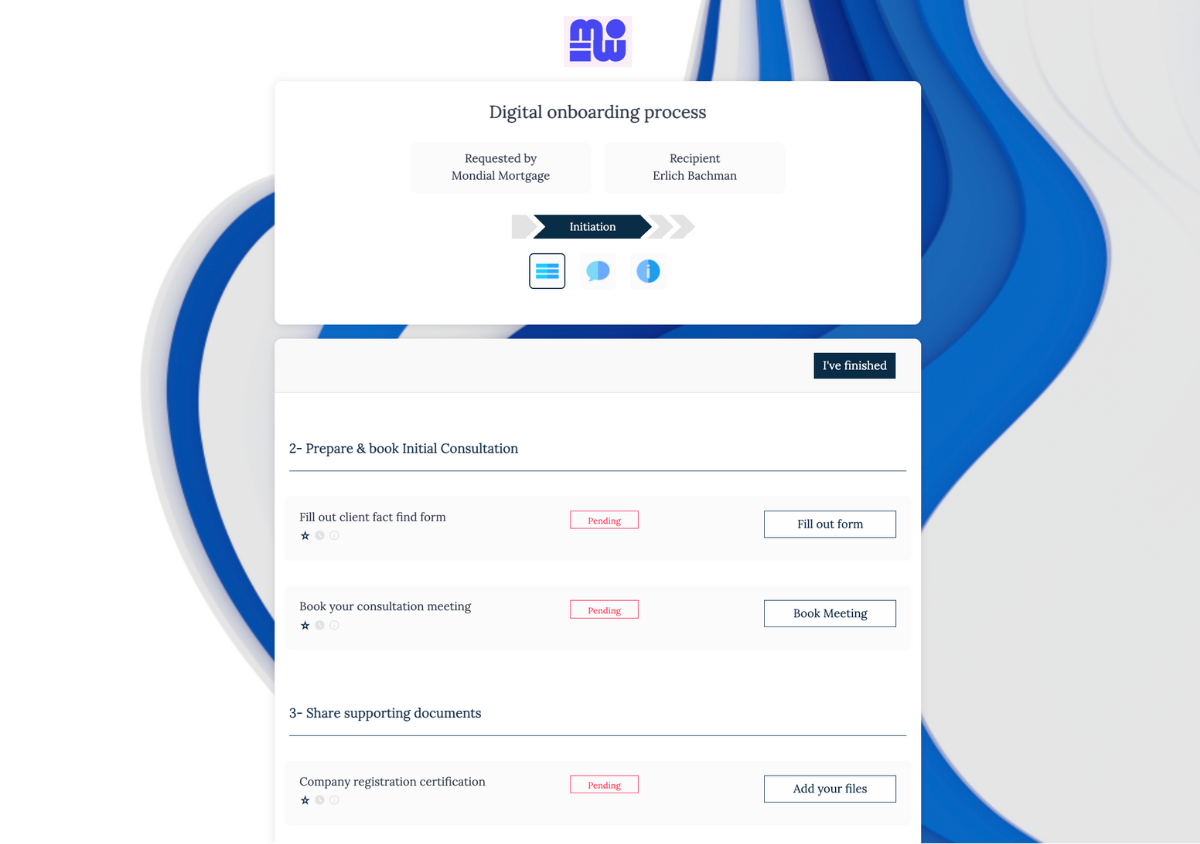
Our digital onboarding process template helps organizations design and run structured online onboarding journeys for new customers, employees, or account holders.
This template is designed for HR professionals, compliance teams, onboarding managers, and business leaders seeking to modernize their onboarding processes.
We’ve built this template as digital onboarding is increasingly adopted across industries such as banking, e-commerce, telecom, and more: it streamlines workflows, reduces errors, and ensures regulatory compliance by delivering a faster, more secure, and user-friendly experience for both organizations and their new customers or employees.
Before exploring this customizable Clustdoc template further, let’s clarify what a digital onboarding process really is and how it compares to traditional methods.
Digital onboarding is the process of acquiring a new customer or subscribing a new user to a service remotely, typically using a mobile device.
It leverages technology to welcome, verify, and integrate new customers or employees remotely, mirroring traditional onboarding but optimized for digital interactions.
This allows users to ‘verify their identity’ online without in-person interaction.
Digital onboarding is the process of acquiring a new customer or subscribing a new user to a service remotely, typically using a mobile device.
In this context, a digital onboarding process would then be the key element defining how organizations onboard stakeholders online by collecting information, verifying identities (when applicable), and validating documents through a structured, end-to-end workflow.
Manual onboarding, on the other hand which is what most organizations are familiar with, refers to traditional onboarding methods that rely on physical forms, emails, and manual data entry, often requiring in-person visits and paper-based documentation.
Unlike manual onboarding, which relies on physical forms, emails, and manual data entry, a digital onboarding process uses digital tools and a centralized digital platform to guide users step by step, at their own pace, while ensuring data consistency and traceability.
In practice, digital onboarding means replacing fragmented onboarding tasks with a single, coordinated onboarding process that connects data collection, identity verification, compliance checks, document processing, and approval stages into one seamless flow.
| Manual onboarding | Digital onboarding |
|---|---|
| Physical forms and emails | Digital documents and online workflows |
| Repeated manual data entry | Automated data capture |
| High risk of human error | Fewer errors through validation |
| Disconnected tools | Centralized onboarding platform |
| Limited visibility | Built-in audit trails |
This Clustdoc digital onboarding process template can be used across multiple teams and contexts:
• Financial institutions, credit unions, and the financial sector
• Digital banking teams onboarding new account holders
• Organizations managing account holders through a signup process
• HR teams handling employee onboarding and new hires
• Distributed organizations supporting remote work
• Businesses focused on customer acquisition, customer retention, and customer satisfaction
Across all use cases, a structured digital onboarding experience supports a seamless onboarding experience and a frictionless onboarding experience aligned with modern customer experience standards.
Next, let’s review the key benefits of implementing a digital onboarding process.
Our template is built around the key components required to onboard people efficiently and consistently across industries.
This section is designed to collect essential personal details and structured customer data directly from users through online forms.
By replacing physical forms with digital data collection, the template ensures information is captured once, stored automatically in the company’s database, and made immediately usable, reducing reliance on manual onboarding and repetitive follow-ups.
This stage is designed to verify the user’s identity as part of a secure onboarding process.
Depending on your organization’s setup, identity verification can be handled manually or connected to an identity verification module.
If you want in regulated environments, such as financial services, this step is commonly used to support KYC or KYB requirements by validating identity documents and confirming the user’s identity through biometric verification, including facial biometrics and liveness detection.
The objective is to reduce fraud risks and ensure compliance while keeping the onboarding flow consistent and auditable.
This section of our template allows teams to request and review all required digital documents needed to support onboarding, such as identity documents, financial records, or personal situation documents for customers, as well as diplomas or employment-related files for employee onboarding.
If needed, you can also plug into this step, automated document processing and optical character recognition using AI.
Clustdoc will then extract and validate data consistently, reducing human error and manual checks during the review stage.
This stage enables your compliance teams and internal stakeholders to review submissions, validate information, and approve submitted files through structured internal validation workflows.
Clustdoc built-in audit trails ensure full traceability across each decision, making the process suitable for highly regulated industries, while optional connections to existing systems allow organizations to align onboarding reviews with their current operational and compliance environments.
A well-designed digital onboarding process should guide users and internal teams through each step without friction, rework, or loss of visibility. This template brings together data collection, identity verification, document review, and internal validation into a single, consistent workflow.
Use our Clustdoc digital onboarding process template to align your teams, reduce operational gaps, and run onboarding processes that are easier to manage, review, and scale.
Download the template and adapt it to your onboarding workflows.
Digitizing an onboarding process involves replacing manual steps with a structured digital workflow. Here are the key steps:
Identify all manual tasks, documents, and validation steps currently involved.
Define the data, documents, and approvals required for each onboarding scenario.
Use online forms and digital documents instead of paper-based workflows.
Integrate identity checks, document validation, and data extraction to reduce manual effort.
Use a digital onboarding platform to monitor progress, store data securely, and maintain audit trails.
Digitizing onboarding improves operational efficiency, reduces errors, and delivers a more consistent onboarding experience for users and internal teams. If you need help, contact our teams.
Yes, our digital onboarding process can be customized by adjusting onboarding steps, data collection forms, validation rules, and approval workflows to your requirements.
This flexibility allow any of your departments to use the same core process across customer onboarding, employee onboarding, and onboarding in highly regulated industries, without rebuilding workflows from scratch.
If you're ready to digitize your onboarding process, you can try it free today.
Before implementing a digital onboarding process, organizations should first clarify which information, documents, and validations are required at each onboarding stage.
This includes identifying mandatory data fields, defining compliance checks, and determining which teams are involved in reviews and approvals. Preparing these elements upfront helps ensure the onboarding process runs smoothly once the template is deployed.
Try Clustdoc today, launch your new workflow tomorrow.