
Customer onboarding has become one of the most sensitive operations for financial institutions.
Verifying customer identity, collecting accurate customer information, and applying a risk-based approach is the backbone of every KYC process.
It influences how financial service providers manage risk, and determines whether a new business relationship can proceed safely.
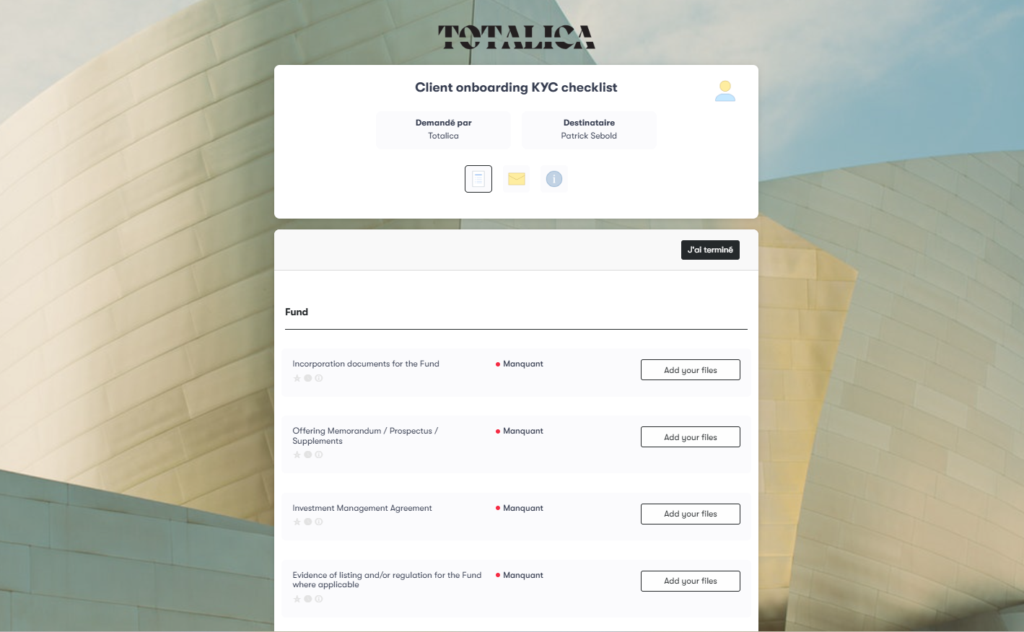
Clustdoc client onboarding KYC checklist gives compliance teams a structured method to gather documents, complete customer due diligence (CDD), and apply consistent KYC procedures across all onboarding workflows.
It supports teams dealing with regulatory requirements, ongoing monitoring obligations, and the increasing pressure to detect financial crimes and money laundering risks.
KYC regulations continue to evolve as global standards tighten and supervisory authorities increase expectations.
In practice, this means that compliance programs must prove they can verify customer identity, document their decisions, and demonstrate that proper risk assessment has taken place.
Without a standardized onboarding process, teams often work with incomplete files, unclear responsibilities, and delays caused by missing KYC documents.
These gaps create operational friction and expose institutions to regulatory sanctions, particularly when dealing with high-risk customers or politically exposed persons.
That’s where a dedicated KYC checklist helps.
It removes uncertainty by ensuring that every reviewer follows the same steps, from customer identification to enhanced due diligence, while maintaining accurate records and supporting ongoing monitoring.
It also ensures that financial institutions apply their compliance program consistently across low-risk clients and high-risk clients.
Customer identification and verification steps
The first stage focuses on gathering reliable information about the client’s identity.
This includes government-issued documents, proof of address, and any additional records required by the customer identification program (CIP).
The objective is simple: confirm that your customer is who they claim to be and ensure your institution meets its initial KYC compliance obligations.
Customer due diligence (CDD)
Once identity is verified, your compliance teams assess the client’s risk profile.
This step involves checking beneficial ownership details, screening the customer against sanctions lists, reviewing their business operations, and documenting any risk factors relevant to the onboarding process.
CDD helps determine whether the client presents indicators of financial crimes, money laundering, or other illegal financial activities.
Enhanced due diligence (EDD)
Some customers require deeper scrutiny, typically high-risk clients, politically exposed persons, or entities with complex structures.
EDD may involve investigating the source of funds, source of wealth, reviewing adverse media, and completing additional identity verification.
These steps reinforce the risk-based approach expected by regulators and help institutions maintain regulatory compliance.
Ongoing and continuous monitoring
Here’s the thing: onboarding is not the end of the KYC process. Financial institutions must maintain accurate records, update customer information regularly, monitor transactions, and review high-risk customers more frequently.
This Clustdoc digital checklist includes guidance on setting review schedules and documenting trends that may indicate changes in customer behaviour or exposure to financial crimes.
Clustdoc digital client onboarding KYC checklist enables compliance teams to bring clarity and consistency to every onboarding workflow.
Instead of relying on manual exchanges or fragmented information, reviewers can follow a clear structure that reduces errors, speeds up decision-making, and ensures that each onboarding process meets regulatory expectations.
Our checklist also reinforces internal risk management practices by documenting decisions, centralizing KYC documents, and giving teams a reliable framework for handling both standard due diligence and more complex enhanced due diligence scenarios.
For institutions handling a high volume of clients or multiple business lines, using a digital KYC onboarding checklist improves oversight and simplifies internal collaboration.
Add this template to your Clustdoc account to create a standardized KYC onboarding process that ensures consistent compliance across all customer onboarding workflows.
Once it’s in your workspace, you can tailor the process to match your specific business requirements, including approval workflows, internal tasks, standard operating procedures, and the exact KYC onboarding steps your team follows.
From there, you’re ready to deploy it with your customers and start collecting KYC documents and customer data in a structured, compliant way.
Beneficial ownership verification is a recurring point of regulatory scrutiny.
This checklist structures the collection of legal entity documents, ownership declarations, and any supporting materials required to confirm ultimate beneficial ownership (UBO).
It also helps teams track situations where indirect ownership, nominee arrangements, or trusts require additional due diligence.
By ensuring that these checks are systematically completed and documented, financial institutions can demonstrate adherence to KYC regulations and prevent exposure to financial crimes involving complex ownership structures.
Regulatory expectations evolve frequently, whether through updates to national AML regulations, FATF guidance, or enforcement priorities.
This checklist provides a structured baseline that can be adapted as regulations change more easily since it's saved as a template, automatically shared with yur team and always accessible from your Clustdoc account.
Book a call to discuss your needs with our experts.